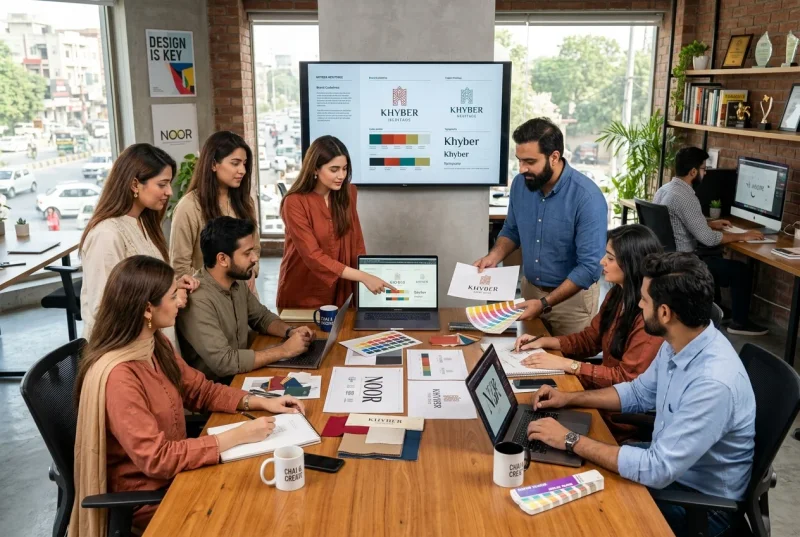
A logo is not your whole brand, but it's the part people see most often: on your website, social profiles, invoices, packaging, vehicles and storefront. A good one makes a small business look established. A poor one makes even a great business look uncertain.
What a good logo needs to do
- Be simple. Clear shapes and few details survive being shrunk to a favicon or app icon.
- Be distinctive. It shouldn't look like your competitors' logos or a generic template.
- Be appropriate. A law firm, a children's brand and a gym need very different feelings.
- Work in one colour. It should still be recognisable in black, white or on a photo.
- Last. Avoid trends that will look dated in two years.
The logo design process, step by step
- Brief and discovery. Your audience, what makes you different, your competitors, where the logo will be used, and words that describe the feeling you want.
- Research. A review of competitors and the wider market to find space to stand out.
- Concepts. Rough sketches exploring different ideas: wordmarks, symbols, monograms and combinations.
- Shortlist and refinement. Two or three directions developed properly in black and white first, then colour.
- Testing. Each option checked at small sizes, on light and dark backgrounds, on mock-ups such as signage and social profiles.
- Final artwork. The chosen logo finished precisely, with spacing, colour codes and variations.
- Handover. All files plus a short brand guide.
Types of logo
| Type | Description | Works well for |
|---|---|---|
| Wordmark | The business name in a distinctive typeface | Short, memorable names |
| Lettermark | Initials or a monogram | Long names, professional firms |
| Symbol | An icon or abstract mark | Brands aiming for global recognition over time |
| Combination | Symbol plus name | Most small and growing businesses |
| Emblem | Name inside a badge or shape | Schools, clubs, food and drink brands |
What you should receive
- Vector files (SVG, EPS or PDF) that scale to any size without blurring.
- PNG files with transparent backgrounds for everyday use.
- Versions: full colour, one colour, white (reversed), horizontal and stacked layouts, and a small icon.
- Colour codes for screen (HEX and RGB) and print (CMYK and Pantone if needed).
- Fonts used, with licence details.
- A short usage guide: clear space, minimum size, and what not to do.
- Full ownership of the final design, transferred in writing.
What drives the cost
Logo design ranges from template sites to full brand identity projects. The cost depends on:
- Research and strategy included before any design starts.
- The number of concepts and rounds of changes.
- The designer's experience and the industry knowledge they bring.
- What's delivered: a logo alone or a full identity with guidelines, stationery and social templates.
- Trademark checks and support.
Be cautious of very cheap options that reuse templates or stock icons; you may not be able to register or protect them. To talk about a project of your own, visit our contact page.
Protecting your logo
- Search trademark databases for similar names and marks in your category before you finalise.
- Register your trademark in the countries where you trade or plan to.
- Keep the design files and the written transfer of ownership.
How this works worldwide
Good logo design works the same way everywhere, but language and protection are local. Design both scripts together if you need English and Arabic, Urdu or French versions. Check colours and symbols for local meanings, and register your trademark in each country where you trade, through the national office or international systems such as the Madrid Protocol.
Common logo mistakes
- Too much detail or too many colours.
- Following a trend that will date quickly.
- Choosing based on personal taste instead of what the audience needs.
- Receiving only a low-resolution JPG.
- Skipping trademark checks.
Frequently Asked Questions
How long does logo design take?
A focused logo project usually takes two to four weeks, including feedback rounds. A full brand identity takes longer.
How many concepts should I expect?
Most designers present two to four strong directions, then refine one. More concepts don't always mean better results.
Should I redesign my existing logo?
Only if it no longer fits your business, doesn't work digitally, or causes confusion. Often a refresh is better than starting again.
Do I own my logo?
Only if ownership is transferred to you in writing. Make sure your contract says so.
Sources & References
Written by Farzeen Rasheed
Ready to improve your marketing results?
Book a free strategy call - we'll audit your current setup and identify the highest-impact fixes.